


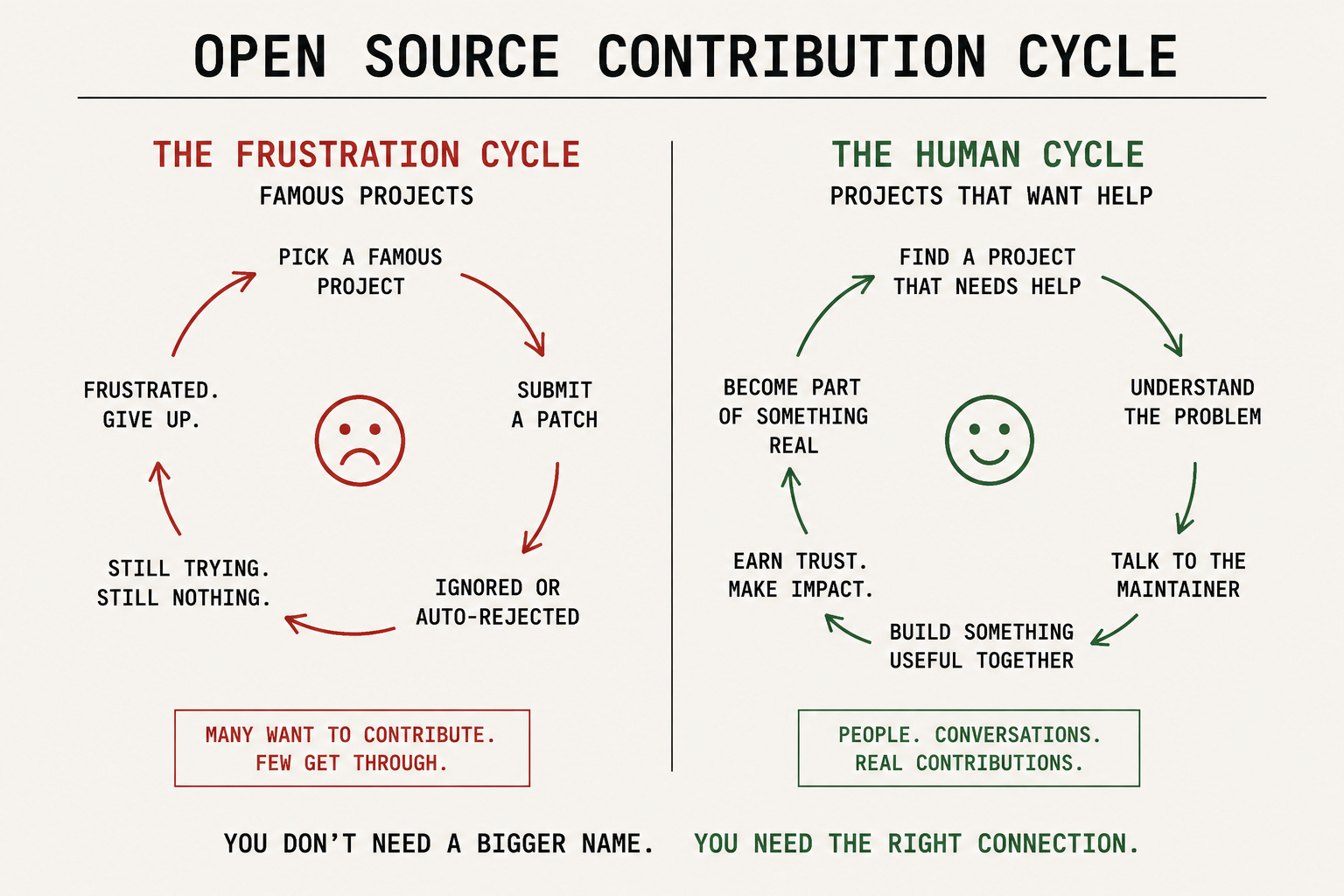
Current open source contribution experience leads to guaranteed frustration on both sides - project and contributor - if you will follow trap of trying contribute to famous projects like Go, React, Node.js, Rust, Kubernetes, or another project everybody knows. All with a dream to find a good first issue, submit a patch, and put the project name on your CV. In the best case scenario you’ll just get some bot response with rejection.
The large projects are not waiting for one more unknown person to send them code. Some are saying this openly. This year tldraw started closing external pull requests automatically. Godot introduced stricter contribution rules, especially for large changes and AI-generated code. GitHub added settings that let maintainers restrict who can open pull requests and limit how many an outside contributor can have open.
And I totally get it, especially while helping on the latest rsync release. A maintainer can receive a patch in seconds and spend hours working out whether it should exist. The code may look perfectly reasonable. You still have to check the original problem, compatibility, tests, old decisions, and whether the contributor will be around when the next release breaks something. AI made it easier to produce the patch. It did not give maintainers more time to review it.
So let the large projects close the queue. There is a lot more open source out there.
That was the reason I built Help Wanted in the first place, few years ago. At the time of writing, it has 650,456 issues from 96,576 projects in its index, from the projects who actually WANT help. Most developers will never hear the names of nearly all these projects.
During the last Hacktoberfest fest I used Help Wanted to find smaller projects and opened three pull requests. All three were reviewed the same day. Someone was actually on the other side.
Meeting a stranger this way can be extremely satisfying. You work on the same problem, explain things to each other, and eventually something works that did not work before. You have been useful to a real person. They understood what you were trying to do. After a few rounds, neither of you feels quite like a stranger anymore. This is what I want from open-source contribution.
We have so many new people being enabled to fulfil their own ideas and it is renaissance of the OSS not the end of it! Bigger projects will find a way how to fix contribution inflow. But we should look at it as opportunity to find the people with the same interests.
This is roughly what I mean by helping your neighbour. It could be a dependency you already use, a small game you like, or a tool maintained by one person in a community you know. Maybe it has fifty stars. Who cares? If the maintainer has asked for help and the problem makes sense to you, your time can have a visible effect there.
We are humans. We need to speak to each other and organize around the things we care about. A pile of unrelated pull requests does not create a community. People create one by returning and remembering each other. At some point they start deciding together what to do next. Small projects still have room for this.
I think most of us are looking for fairly ordinary things in the end. We want to have some fun. We want to be useful. We want the people we work with to understand why we care. This is much easier to find in a small community than in a queue where your name is one of thousands.
And if you are open source maintainer struggling with inflow of contributions, or code quality, feel free to send me a note - I can help.